what led nicolaus copernicus to investigate the motions of the universes spheres?
Nicolaus Copernicus biography: Facts & discoveries
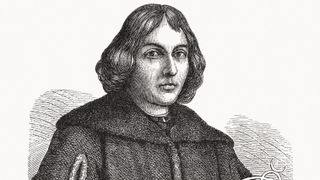
Nicolaus Copernicus proposed his theory that the planets revolved around the sun in the 1500s, when most people believed that Earth was the heart of the universe. Although his model wasn't completely correct, it formed a potent foundation for futurity scientists, such as Galileo, to build on and improve humanity's understanding of the movement of heavenly bodies.
Indeed, other astronomers built on Copernicus' work and proved that our planet is just one world orbiting one star in a vast cosmos loaded with both, and that we're far from the center of anything.
Countdown: The virtually famous astronomers of all fourth dimension
Pedagogy
Born on Feb. nineteen, 1473, in Toruń, Poland, Mikolaj Kopernik (Copernicus is the Latinized form of his name) traveled to Italian republic to attend college, according to the Encyclopedia Britannica (opens in new tab). Copernicus' father had died when the kid was young, and his uncle became a leading figure in his life.
Copernicus' uncle wanted him to study the laws and regulations of the Catholic Church building then return dwelling house to become a catechism, a type of official in the Catholic Church building.
Yet, while visiting several bookish institutions, Copernicus spent almost of his time studying mathematics and astronomy. While attention the Academy of Bologna, Copernicus lived and worked with astronomy professor Domenico Maria de Novara, doing research and helping him make observations of the heavens.
Due to his uncle'south influence, Copernicus did go a catechism in Warmia, in northern Poland, although he never took orders as a priest. He conducted his astronomical enquiry in between his duties every bit canon, the Encyclopedia Britannica noted.
The Copernican model of the solar organization
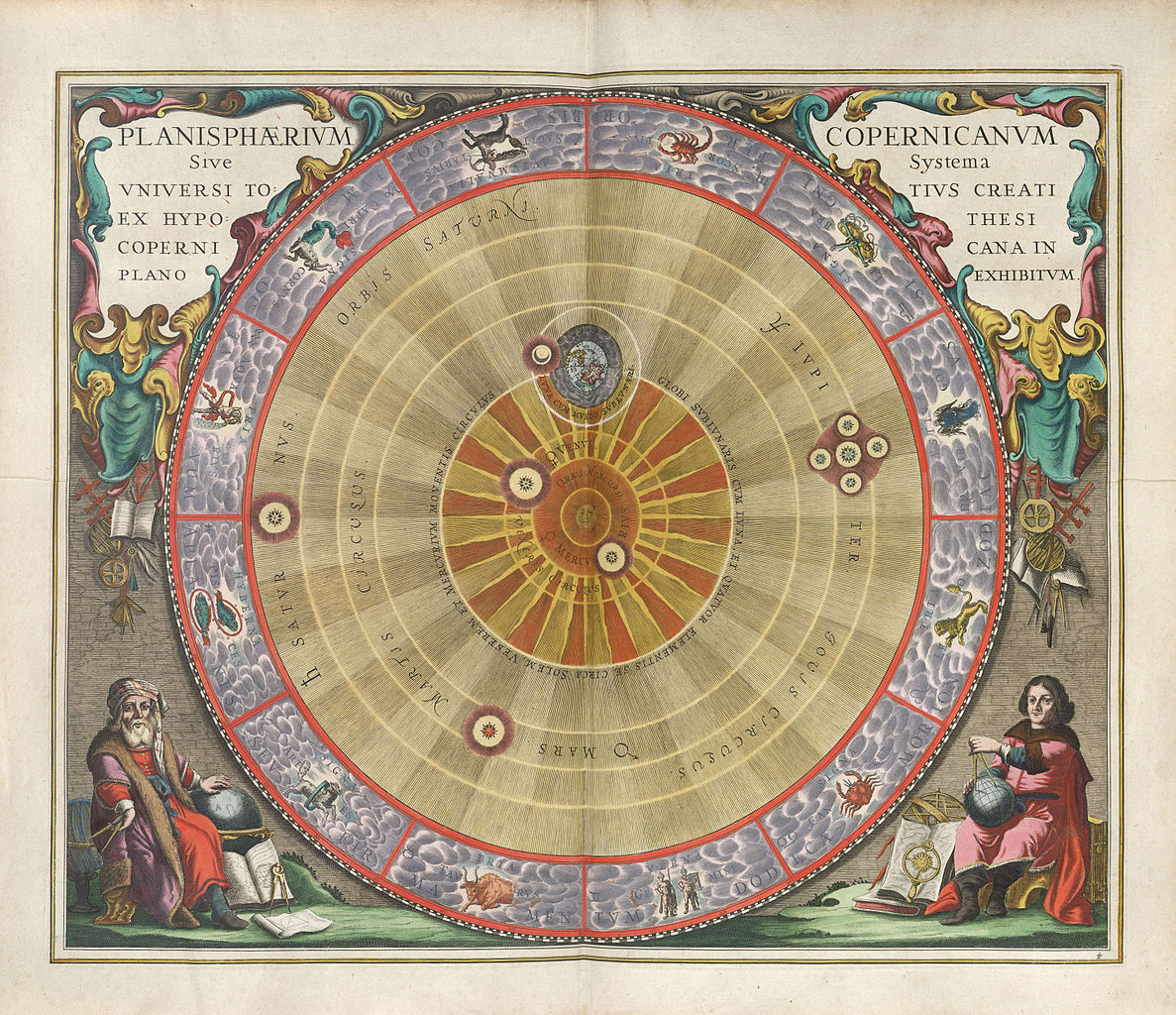
In Copernicus' lifetime, most believed that Earth held its place at the heart of the universe. The sun, the stars, and all of the planets revolved around it.
One of the glaring mathematical problems with this model was that the planets, on occasion, would travel backward across the heaven over several nights of ascertainment. Astronomers called this retrograde motility. To account for it, the electric current model, based on the Greek astronomer and mathematician Ptolemy'due south view, incorporated a number of circles within circles — epicycles — inside of a planet'south path. Some planets required equally many as seven circles, creating a cumbersome model many felt was likewise complicated to have naturally occurred.
In 1514, Copernicus distributed a handwritten volume to his friends that fix out his view of the universe. In it, he proposed that the center of the universe was not Earth, but that the lord's day lay virtually it. He also suggested that Earth's rotation accounted for the rise and setting of the sunday, the motility of the stars, and that the cycle of seasons was caused by Earth'south revolutions effectually information technology.
Finally, he (correctly) proposed that Earth's motion through space caused the retrograde motility of the planets across the night sky (planets sometimes move in the aforementioned directions as stars, slowly across the sky from night to dark, but sometimes they move in the opposite, or retrograde, direction).
Copernicus finished the outset manuscript of his book, "De Revolutionibus Orbium Coelestium" ("On the Revolutions of the Heavenly Spheres (opens in new tab)") in 1532. In it, Copernicus established that the planets orbited the dominicus rather than the Earth. He laid out his model of the solar system and the path of the planets.
He didn't publish the book, nevertheless, until 1543, only two months before he died. He diplomatically dedicated the book to Pope Paul Iii. The church did not immediately condemn the volume every bit heretical, perhaps considering the printer added a note that said even though the book's theory was unusual, if it helped astronomers with their calculations, it didn't thing if information technology wasn't really true. It probably as well helped that the subject was so difficult that but highly educated people could understand it. The Church did eventually ban the volume in 1616, according to Physics Today.
The Catholic Church wasn't the but Christian faith to reject Copernicus' idea.
"When 'De Revolutionibus Orbium Coelestium' was published in 1543, religious leader Martin Luther voiced his opposition to the heliocentric solar system model," says Biography.com. "His underling, Lutheran minister Andreas Osiander, quickly followed suit, saying of Copernicus, 'This fool wants to plough the whole fine art of astronomy upside down.'"
Copernicus died on May 24, 1543, of a stroke. He was lxx.
Where was Copernicus cached?
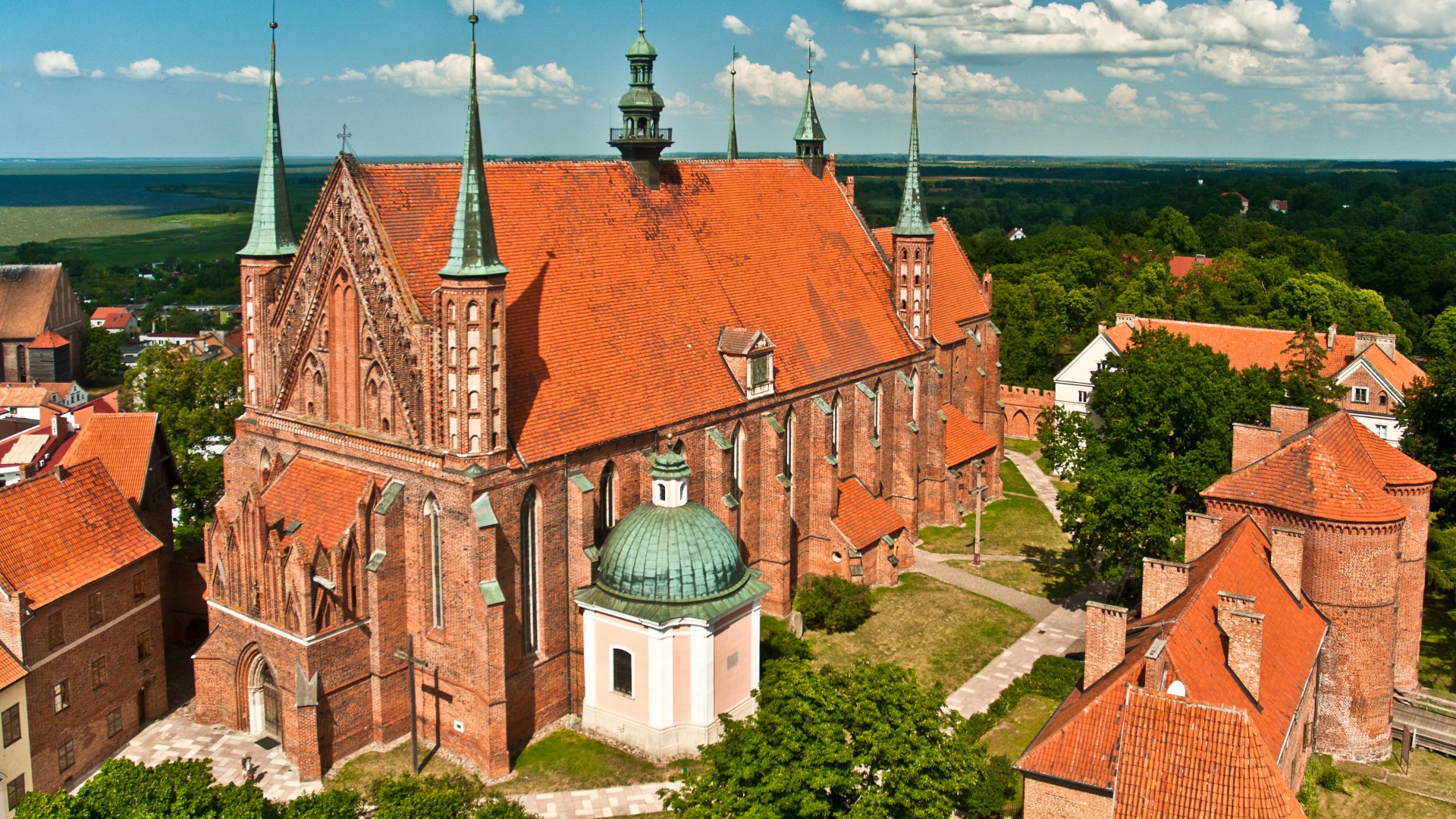
In 2008, researchers announced that a skull establish in Frombork Cathedral did belong to the astronomer, according to The Guardian (opens in new tab). By matching DNA from the skull to hairs found in books once owned by Copernicus, the scientists confirmed the identity of the astronomer. Polish police and so used the skull to reconstruct how its possessor might have looked.
Nature (opens in new tab) quotes the AFP as stating that the reconstruction "bore a striking resemblance to portraits of the immature Copernicus."
In 2010, his remains were blessed with holy water by some of Poland'southward highest-ranking clerics before existence reburied, his grave marked with a black granite tombstone decorated with a model of the solar system. The tomb marks both his scientific contribution and his service equally church catechism.
"Today's funeral has symbolic value in that it is a gesture of reconciliation between scientific discipline and organized religion," Jacek Jezierski, a local bishop who encouraged the search for Copernicus, said according to the Associated Printing (opens in new tab). "Science and faith can exist reconciled."
The unmarked grave was not linked to suspicions of heresy, as his ideas were just just being discussed and had withal to be forcefully condemned, co-ordinate to Jack Repcheck, author of "C (opens in new tab)opernicus' Secret: How the Scientific Revolution Began (opens in new tab)."
"Why was he just buried along with everyone else, similar every other canon in Frombork?" Repcheck said. "Considering at the time of his death he was just any other canon in Frombork. He was not the iconic hero that he has go."
Refining the piece of work of Copernicus
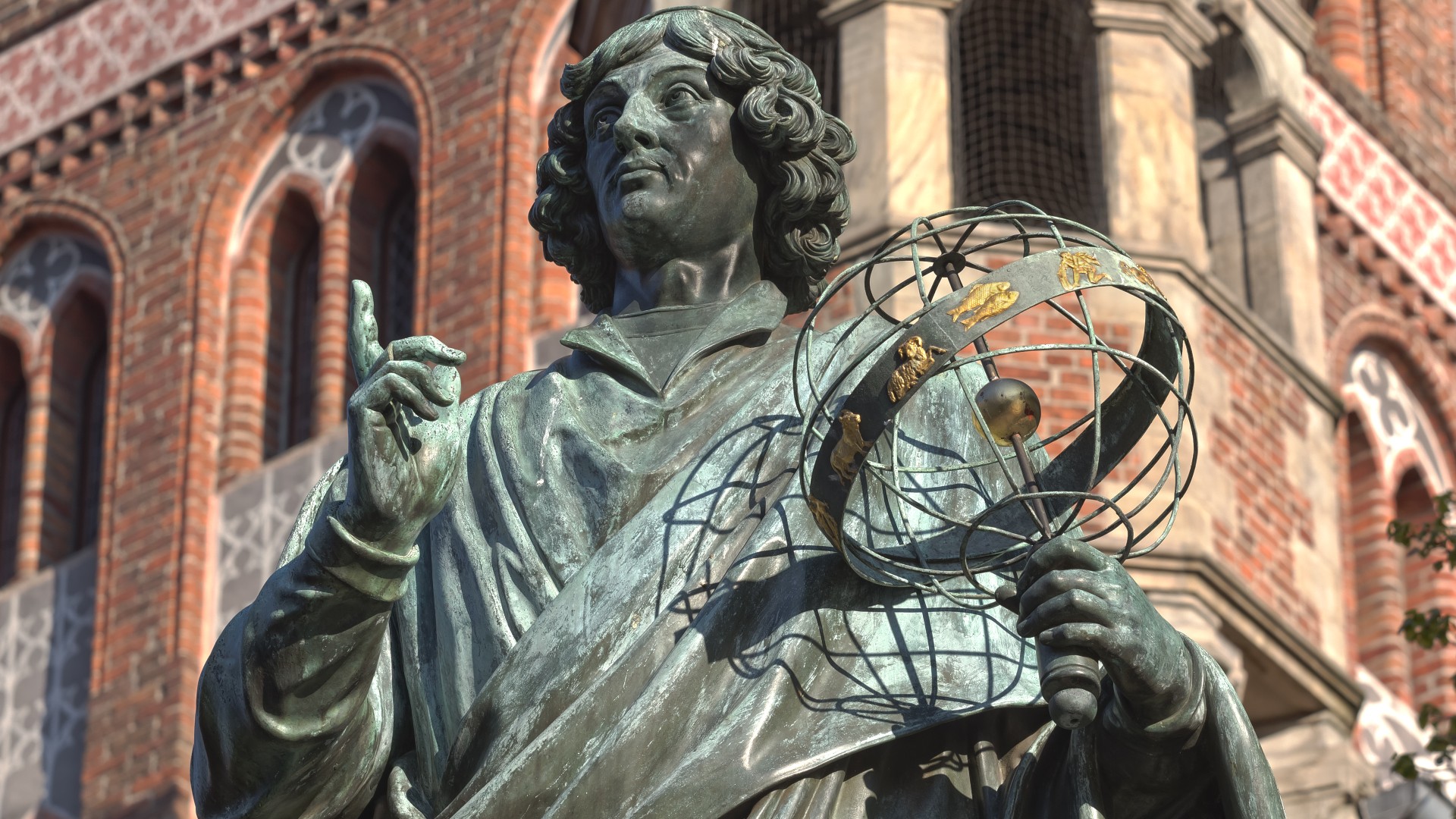
Although Copernicus' model inverse the layout of the universe, information technology still had its faults. For one thing, Copernicus held to the classical idea that the planets traveled in perfect circles. It wasn't until the 1600s that Johannes Kepler proposed the orbits were instead ellipses. As such, Copernicus' model featured the aforementioned epicycles that marred Ptolemy's work, although there were fewer.
Copernicus' ideas took well-nigh a hundred years to seriously have hold. When Galileo Galilei claimed in 1632 that Globe orbited the sun, building upon the Polish astronomer's piece of work, he found himself under business firm arrest for committing heresy against the Catholic Church.
Despite this, the observations of the universe proved the two men correct in their understanding of the motility of celestial bodies. Today, we call the model of the solar system, in which the planets orbit the sunday, a heliocentric or Copernican model.
"Sometimes Copernicus is honored as having substituted the old geocentric organisation with the new, heliocentric 1, as having regarded the sun, instead of the Earth, every bit the unmoving heart of the universe," Konrad Rudnicki, an astronomer and author of "The Cosmological Principles (opens in new tab)," wrote. "This view, while quite correct, does non return the actual significance of Copernicus'southward work."
According to Rudnicki, Copernicus went across just creating a model of the solar organisation.
"All his piece of work involved a new cosmological principle originated by him. Information technology is today chosen the 18-carat Copernican Cosmological Principle and says, 'The Universe equally observed from any planet looks much the same,'" Rudnicki wrote.
So while Copernicus' model physically placed the sun at the center of the solar arrangement, it also figuratively removed the focus from Earth, making it just another planet.
Additional resources
You can read the English translation of Copernicus' manuscript "De Revolutionibus Orbium Cœlestium" hither (opens in new tab). Check out the complete works of Nicholas Copernicus Consummate in "On the Revolutions: Nicholas Copernicus Complete Works (Foundations of Natural History) (opens in new tab)". Likewise, discover the many artefacts at the British Museum regarding Nicolaus Copernicus, hither (opens in new tab).
Bibliography
Jack Repcheck, "Copernicus' Hole-and-corner: How the Scientific Revolution Began (opens in new tab)," Simon & Schuster, 2008.
Sheila Rabin, "Nicolaus Copernicus," The Stanford Encyclopedia of Philosophy, 2019.
Fred Hoyle, "The work of Nicolaus Copernicus," Proceedings of the Royal Society A, Book 336, January 1974, https://doi.org/10.1098/rspa.1974.0009 (opens in new tab).
Teresa Zielinska, "Nicolaus Copernicus (1473–1543)," Distinguished Figures in Mechanism and Machine Scientific discipline, History of Mechanism and Motorcar Scientific discipline Volume 1, 2007, https://doi.org/10.1007/978-1-4020-6366-4_5 (opens in new tab)
Join our Space Forums to proceed talking space on the latest missions, nighttime heaven and more! And if you have a news tip, correction or comment, let us know at: customs@space.com.
johnsonposiciente.blogspot.com
Source: https://www.space.com/15684-nicolaus-copernicus.html
0 Response to "what led nicolaus copernicus to investigate the motions of the universes spheres?"
Enregistrer un commentaire