Why Is It Called a Hamburger if It's Made Out of Beef
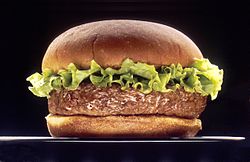 Hamburger | |
| Course | Main course |
|---|---|
| Place of origin | Germany or U.s.a. (disputed) |
| Created by | |
| Serving temperature | Hot |
| Master ingredients | Basis meat, bread |
| |
 Cookbook: Hamburger
 Media: Hamburger
A hamburger (or burger for short) is a food consisting of fillings —usually a patty of ground meat, typically beefiness—placed inside a sliced bun or staff of life roll. Hamburgers are often served with cheese, lettuce, tomato, onion, pickles, salary, or chilis; condiments such as ketchup, mustard, mayonnaise, relish, or a "special sauce", often a variation of Thousand Island dressing; and are often placed on sesame seed buns. A hamburger topped with cheese is called a cheeseburger.[1]
The term burger can likewise be applied to the meat patty on its ain, peculiarly in the United kingdom, where the term patty is rarely used, or the term can even refer just to ground beef. Since the term hamburger normally implies beef, for clarity burger may be prefixed with the type of meat or meat substitute used, as in beefiness burger, turkey burger, bison burger, portobello burger, or veggie burger. In Australia and New Zealand, a piece of chicken breast on a bun is known equally a chicken burger, which would generally not be considered to be a burger in the United states; where it would generally be called a chicken sandwich, but in Australian English and New Zealand English a sandwich requires sliced breadstuff (not a bun), so information technology would non exist considered a sandwich.[ii] [3]
Hamburgers are typically sold at fast-food restaurants, diners, and specialty and high-stop restaurants. At that place are many international and regional variations of hamburgers.
Etymology and terminology
The term hamburger originally derives from Hamburg, the 2d-largest metropolis in Federal republic of germany; however, there is no certain connection between the food and the urban center.[4]
Hamburger and fries in Tokyo.
Past back-germination, the term "burger" somewhen became a cocky-standing word that is associated with many different types of sandwiches, like to a (ground meat) hamburger, but fabricated of different meats such every bit buffalo in the buffalo burger, venison, kangaroo, craven, turkey, elk, lamb or fish like salmon in the salmon burger, but even with meatless sandwiches equally is the case of the veggie burger.[5]
History


The "Hamburger Rundstück" was popular already in 1869, and is believed to be a precursor to the modern Hamburger.

Cheeseburger (with onions and tomatoes) at Louis' Luncheon, New Haven, Connecticut
As versions of the meal take been served for over a century, its origin remains cryptic.[6] The popular book The Art of Cookery Fabricated Obviously and Easy past Hannah Glasse included a recipe in 1758 every bit "Hamburgh sausage", which suggested to serve information technology "roasted with toasted staff of life under information technology". A similar snack was besides pop in Hamburg by the name "Rundstück warm" ("breadstuff gyre warm") in 1869 or earlier,[7] and supposedly eaten by many emigrants on their way to America, but may have independent roasted beefsteak rather than Frikadeller. Hamburg steak is reported to accept been served between two pieces of bread on the Hamburg America Line, which began operations in 1847. Each of these may mark the invention of the Hamburger, and explain the proper name.
There is a reference to a "Hamburg steak" equally early equally 1884 in the Boston Journal.[OED, under "steak"] On July five, 1896, the Chicago Daily Tribune fabricated a highly specific claim regarding a "hamburger sandwich" in an article about a "Sandwich Car": "A distinguished favorite, merely five cents, is Hamburger steak sandwich, the meat for which is kept gear up in modest patties and 'cooked while you wait' on the gasoline range."[8]
Claims of invention
The origin of the hamburger is unclear, though "hamburger steak sandwiches" take been advertised in U.S. newspapers from New York to Hawaii since at least the 1890s.[9] The invention of hamburgers is commonly attributed to various people, including Charlie Nagreen, Frank and Charles Menches, Oscar Weber Bilby, Fletcher Davis, or Louis Lassen.[10] [11] White Castle traces the origin of the hamburger to Hamburg, Germany with its invention by Otto Kuase.[12] Some have pointed to a recipe for "Hamburgh sausages" on toasted bread, which was published in "The Fine art of Cookery Made Evidently and Easy" past Hannah Glasse in 1747.[9] However, hamburgers gained national recognition at the 1904 St. Louis World's Off-white when the New York Tribune referred to the hamburger as "the innovation of a food vendor on the pike".[xi] No conclusive argument has e'er ended the dispute over invention. An article from ABC News sums up: "One trouble is that in that location is little written history. Some other issue is that the spread of the burger happened largely at the World's Fair, from tiny vendors that came and went in an instant. And it is entirely possible that more than than one person came upwards with the idea at the same fourth dimension in different parts of the country."[13]
Louis Lassen
Although debunked past the Washington Mail service,[ix] a popular myth recorded by Connecticut Congresswoman Rosa DeLauro stated the showtime hamburger served in America was past Louis Lassen, a Danish immigrant, afterwards he opened Louis' Lunch in New Oasis in 1895.[fourteen] Louis' Lunch, a small tiffin railroad vehicle in New Haven, Connecticut, is said to have sold the get-go hamburger and steak sandwich in the U.S. in 1900.[15] [16] [17] New York Magazine states that "The dish actually had no name until some rowdy sailors from Hamburg named the meat on a bun after themselves years later", noting also that this merits is subject area to dispute.[18] A customer ordered a quick hot meal and Louis was out of steaks. Taking ground beef trimmings, Louis made a patty and grilled information technology, putting information technology between 2 slices of toast.[eleven] Some critics like Josh Ozersky, a food editor for New York Magazine, claim that this sandwich was not a hamburger considering the bread was toasted.[19]
Charlie Nagreen
One of the earliest claims comes from Charlie Nagreen, who in 1885 sold a meatball between two slices of staff of life at the Seymour Fair[twenty] now sometimes called the Outagamie County Fair.[19] The Seymour Community Historical Society of Seymour, Wisconsin, credits Nagreen, now known equally "Hamburger Charlie", with the invention. Nagreen was fifteen when he was reportedly selling pork sandwiches at the 1885 Seymour Off-white, made so customers could swallow while walking. The Historical Society explains that Nagreen named the hamburger after the Hamburg steak with which local German immigrants were familiar.[21] [22]
Otto Kuase
Co-ordinate to White Castle, Otto Kuase was the inventor of the hamburger. In 1891, he created a beefiness patty cooked in butter and topped with a fried egg. German language sailors would later omit the fried egg.[11]
Oscar Weber Bilby
The family of Oscar Weber Bilby claim the first-known hamburger on a bun was served on July iv, 1891, on Grandpa Oscar's farm. The bun was a yeast bun.[23] [24] [25] In 1995, Governor Frank Keating proclaimed that the offset truthful hamburger on a bun was created and consumed in Tulsa, Oklahoma in 1891, calling Tulsa, "The Existent Birthplace of the Hamburger."[26]
Frank and Charles Menches

A bacon cheeseburger, from a New York Metropolis diner
Frank and Charles Menches claim to have sold a ground beef sandwich at the Erie County Fair in 1885 in Hamburg, New York.[19] During the fair, they ran out of pork sausage for their sandwiches and substituted beef.[xx] The brothers exhausted their supply of sausage, then purchased chopped up beefiness from a butcher, Andrew Klein. Historian Joseph Streamer wrote that the meat was from Stein's market non Klein'southward, despite Stein's having sold the marketplace in 1874.[20] The story notes that the name of the hamburger comes from Hamburg, New York, not Hamburg, Deutschland.[20] Frank Menches's obituary in The New York Times states that these events took place at the 1892 Acme County Fair in Akron, Ohio.[27]
Fletcher Davis
Fletcher Davis of Athens, Texas claimed to have invented the hamburger. According to oral histories, in the 1880s he opened a luncheon counter in Athens and served a 'burger' of fried footing beef patties with mustard and Bermuda onion between two slices of bread, with a pickle on the side.[11] The story is that in 1904, Davis and his wife Ciddy ran a sandwich stand at the St. Louis Earth's Fair.[11] Historian Frank X. Tolbert, noted that Athens resident Clint Murchison said his grandad dated the hamburger to the 1880s with 'Old Dave' a.k.a. Fletcher Davis.[xx] A photo of "Old Dave's Hamburger Stand up" from 1904 was sent to Tolbert as evidence of the claim.[20]
Other hamburger-steak claims
Various non-specific claims of invention relate to the term "hamburger steak" without mention of its being a sandwich. The first printed American menu which listed hamburger is said to exist an 1834 bill of fare from Delmonico's in New York.[28] However, the printer of the original menu was not in business in 1834.[25] In 1889, a card from Walla Walla Marriage in Washington offered hamburger steak as a carte item.[xi]
Between 1871 and 1884, "Hamburg Beefsteak" was on the "Breakfast and Supper Carte du jour" of the Clipper Restaurant at 311/313 Pacific Street in San Fernando, California. It toll 10 cents—the same cost as mutton chops, grunter's feet in concoction, and stewed veal. Information technology was not, nevertheless, on the dinner bill of fare. Only "Squealer'due south Caput", "Calf Tongue", and "Stewed Kidneys" were listed.[29] Some other claim ties the hamburger to Summit County, New York or Ohio. Summit County, Ohio exists, merely Summit County, New York does not.[twenty]
Early on major vendors
- 1921: White Castle, Wichita, Kansas. Due to widely anti-German sentiment in the U.S. during Earth War I, an alternative proper noun for hamburgers was Salisbury steak. Following the war, hamburgers became unpopular until the White Castle eatery concatenation marketed and sold large numbers of small 65 mm (ii+ 1⁄2 in) foursquare hamburgers, known every bit sliders [ citation needed ]. They started to create five holes in each patty, which assist them cook evenly and eliminate the need to flip the burger. In 1995 White Castle began selling frozen hamburgers in convenience stores and vending machines.[30]
- 1923: Kewpee Hamburgers, or Kewpee Hotels, Flint, Michigan. Kewpee was the second hamburger concatenation and peaked at 400 locations before World War 2. Many of these were licensed but not strictly franchised. Many airtight during WWII. Betwixt 1955 and 1967, another wave airtight or caused changes of proper name. In 1967 the Kewpee licensor moved the company to a franchise system. Currently just 5 locations exist.
- 1926: White Tower Hamburgers
- 1927: Footling Tavern
- 1930s: White Castle (Ii; run by Henry Cassada)
- 1931: Krystal (eating place)[31]
- 1936: Big Male child. In 1937, Bob Wian created the double deck hamburger at his hamburger stand in Glendale California. Big Boy would go the proper name of the hamburger, the mascot and the restaurants. Big Boy expanded nationally through regional franchising and subfranchising. Primarily operating every bit drive-in restaurants in the 1950s, interior dining gradually replaced adjourn service by the early 1970s. Many franchises have airtight or operate independently, only at the remaining American restaurants, the Large Male child double deck hamburger remains the signature item.
- 1940: McDonald'due south restaurant, San Bernardino, California, was opened by Richard and Maurice McDonald. Their introduction of the "Speedee Service Arrangement" in 1948 established the principles of the modern fast-food restaurant. The McDonald brothers began franchising in 1953. In 1961, Ray Kroc (the supplier of their multi-mixer milkshake machines) purchased the company from the brothers for $ii.7 meg and a 1.9% royalty.[32]
Today

Hamburger preparation in a fast food institution
Hamburgers are usually a characteristic of fast food restaurants. The hamburgers served in major fast food establishments are usually mass-produced in factories and frozen for delivery to the site.[33] These hamburgers are thin and of uniform thickness, differing from the traditional American hamburger prepared in homes and conventional restaurants, which is thicker and prepared by hand from ground beef. Most American hamburgers are round, but some fast-food bondage, such as Wendy's, sell square-cut hamburgers. Hamburgers in fast food restaurants are ordinarily grilled on a flat-tiptop, but some firms, such every bit Burger King, use a gas flame grilling process. At conventional American restaurants, hamburgers may be ordered "rare", but normally are served medium-well or well-done for nutrient safety reasons. Fast food restaurants practise not commonly offer this pick.
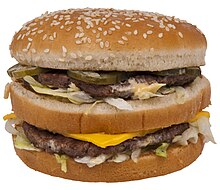
The McDonald's fast-food chain sells the Big Mac, ane of the world's top selling hamburgers, with an estimated 550 million sold annually in the The states.[34] Other major fast-nutrient chains, including Burger King (also known equally Hungry Jack'south in Australia), A&W, Culver'south, Whataburger, Carl'southward Jr./Hardee's chain, Wendy'due south (known for their square patties), Jack in the Box, Cook Out, Harvey's, Shake Shack, In-Due north-Out Burger, Five Guys, Fatburger, Vera'south, Burgerville, Back G Burgers, Lick's Homeburger, Roy Rogers, Smashburger, and Sonic also rely heavily on hamburger sales. Fuddruckers and Red Robin are hamburger chains that specialize in the mid-tier "restaurant-way" diverseness of hamburgers.


A hamburger with fries bought as have-away, with the hamburger and the fries in separate containers.

Some hamburgers have a black bun, usually coloured with squid ink.
Some restaurants offering elaborate hamburgers using expensive cuts of meat and diverse cheeses, toppings, and sauces. One example is the Bobby's Burger Palace chain founded past well-known chef and Food Network star Bobby Flay.
Hamburgers are oftentimes served equally a fast dinner, picnic or party nutrient and are often cooked outdoors on barbecue grills.
A high-quality hamburger patty is fabricated entirely of footing (minced) beef and seasonings; these may be described equally "all-beef hamburger" or "all-beef patties" to distinguish them from inexpensive hamburgers made with cost-savers like added flour, textured vegetable protein, ammonia treated defatted beef trimmings (which the visitor Beefiness Products Inc, calls "lean finely textured beef"),[35] [36] advanced meat recovery, or other fillers. In the 1930s ground liver was sometimes added. Some cooks prepare their patties with binders like eggs or breadcrumbs. Seasonings may include salt and pepper and others like as parsley, onions, soy sauce, Grand Island dressing, onion soup mix, or Worcestershire sauce. Many name brand seasoned salt products are also used.
Condom
Raw hamburger may comprise harmful leaner that can produce food-borne illness such as Escherichia coli O157:H7, due to the occasional initial improper preparation of the meat, then caution is needed during handling and cooking. Because of the potential for food-borne illness, the USDA recommends hamburgers be cooked to an internal temperature of 160 °F (71 °C).[37] If cooked to this temperature, they are considered well-washed.[38]
Variations
Other meats
Burgers can besides be made with patties made from ingredients other than beef.[39] For example, a turkey burger uses ground turkey meat, a chicken burger uses footing chicken meat. A buffalo burger uses basis meat from a bison, and an ostrich burger is made from ground seasoned ostrich meat. A deer burger uses footing venison from deer.[40]
Veggie burgers
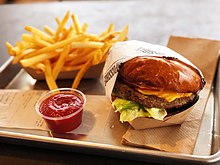
Vegetarian and vegan burgers can be formed from a meat analogue, a meat substitute such as tofu, TVP, seitan (wheat gluten), quorn, beans, grains or an assortment of vegetables, footing up and mashed into patties.
Vegetable patties have existed in diverse Eurasian cuisines for millennia, and are a commonplace particular in Indian cuisine.
Steak burgers

A steak burger with cheese and onion rings
A steak burger is a marketing term for a hamburger claimed to be of superior quality,[41] [42] [43] except in Australia, where it is a sandwich containing a steak.
Use of the term "steakburger" dates to the 1920s in the Usa.[44] In the U.Southward. in 1934, A.H. "Gus" Belt, the founder of Steak 'n Shake, devised a higher-quality hamburger and offered it as a "steakburger" to customers at the company'due south first location in Normal, Illinois.[45] This burger used a combination of ground meat from the strip portion of T-bone steak and sirloin steak in its preparation.[45] Steak burgers are a primary menu particular at Steak 'n Shake restaurants,[45] and the company'southward registered trademarks included "original steakburger" and "famous for steakburgers".[46] Steak 'n Shake's "Prime Steakburgers" are now made of option grade brisket and chuck.[47]
Beef is typical, although other meats such as lamb and pork may also be used.[48] The meat is ground[49] or chopped.[50]
In Australia, a steak burger is a steak sandwich which contains a whole steak, not ground meat.[51]
Steak burgers may be cooked to various degrees of doneness.[52]
Steak burgers may be served with standard hamburger toppings such every bit lettuce, onion, and tomato.[52] Some may have additional various toppings such every bit cheese,[52] bacon, fried egg, mushrooms,[53] additional meats,[54] and others.
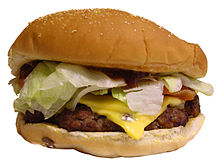
Diverse fast food outlets and restaurants — such as Burger Rex, Carl's Jr., Hardee'south, IHOP, Steak 'northward Shake, Mr. Steak, and Freddy'southward — market steak burgers.[44] [46] [55] [56] [57] Some restaurants offer loftier-end burgers prepared from aged beef.[58] Additionally, many restaurants have used the term "steak burger" at diverse times.[56]
Some baseball parks concessions in the U.s. telephone call their hamburgers steak burgers, such every bit Johnny Rosenblatt Stadium in Omaha, Nebraska.[59]
Burger Male monarch introduced the Sirloin Steak sandwich in 1979 every bit role of a bill of fare expansion that in turn was part of a corporate restructuring endeavor for the company.[44] It was a single oblong patty made of chopped steak served on a sub-mode, sesame seed roll.[sixty] [61] Boosted steak burgers that Burger King has offered are the Angus Bacon Cheddar Ranch Steak Burger, the Angus Bacon & Cheese Steak Burger, and a limited edition Stuffed Steakhouse Burger.[44]
In 2004, Steak 'north Shake sued Burger King over the latter's use of term Steak Burger in conjunction with one of its menu items, challenge that such use infringed on trademark rights.[62] [63] (According to the St. Louis Post-Acceleration, Burger Rex's attorneys "grilled" Steak 'n Shake's CEO in courtroom about the precise content of Steak 'northward Shake's steakburger offering.)[62] The instance was settled out of court.[64]
United States and Canada


The hamburger is considered a national dish of the United States.[65] In the United states of america and Canada, burgers may exist classified as ii main types: fast food hamburgers and individually prepared burgers made in homes and restaurants. The latter are often prepared with a variety of toppings, including lettuce, lycopersicon esculentum, onion, and often sliced pickles (or pickle relish). French fries oft accompany the burger. Cheese (usually processed cheese slices only ofttimes Cheddar, Swiss, pepper jack, or blue), either melted directly on the meat patty or crumbled on pinnacle, is mostly an pick.
Condiments might be added to a hamburger or may be offered separately on the side including ketchup, mustard, mayonnaise, relish, salad dressings and charcoal-broil sauce.
Other toppings can include bacon, avocado or guacamole, sliced sautéed mushrooms, cheese sauce, chili (unremarkably without beans), fried egg, scrambled egg, feta cheese, blueish cheese, salsa, pineapple, jalapeños and other kinds of chili peppers, anchovies, slices of ham or bologna, pastrami or teriyaki-seasoned beef, tartar sauce, french fries, onion rings or murphy chips.
- Standard toppings on hamburgers may depend upon location, particularly at restaurants that are not national or regional franchises.
- Restaurants may offer hamburgers with multiple meat patties. The most mutual variants are double and triple hamburgers, but California-based burger chain In-North-Out once sold a sandwich with ane hundred patties, chosen a "100x100."[66]
- Pastrami burgers may be served in Salt Lake Urban center, Utah.[67]
- A patty melt consists of a patty, sautéed onions and cheese between two slices of rye bread. The sandwich is then buttered and fried.
- A slider is a very small square hamburger patty, served on an equally small bun and ordinarily sprinkled with diced onions. According to the earliest citations, the proper name originated aboard U.Due south. Navy ships, due to the mode in which greasy burgers slid beyond the galley grill every bit the ship pitched and rolled.[68] [69] Other versions claim the term "slider" originated from the hamburgers served by flight line galleys at armed forces airfields, which were and so greasy they slid correct through i; or because their small size allows them to "slide" right down the throat in one or two bites.
- In Alberta, Canada a "kubie burger" is a hamburger made with a pressed Ukrainian sausage (kubasa).[70]
- A butter burger, constitute commonly throughout Wisconsin and the upper midwest is a normal burger with a pad of butter as a topping, or a heavily buttered bun. It is the signature bill of fare item of the restaurant concatenation Culver'southward.[71]
- The Fat Male child, is an iconic hamburger with chili meat sauce originating in the Greek burger restaurants of Winnipeg, Manitoba[72]
- In Minnesota, a "Juicy Lucy" (also spelled "Jucy Lucy"), is a hamburger having cheese inside the meat patty rather than on elevation. A slice of cheese is surrounded by raw meat and cooked until it melts, resulting in a molten core of cheese within the patty. This scalding hot cheese tends to gush out at the beginning bite, so servers frequently instruct customers to let the sandwich absurd for a few minutes earlier consumption.
- A depression carb burger is a hamburger served without a bun and replaced with big slices of lettuce with mayonnaise or mustard existence the sauces primarily used.[73] [74] [75]
- A ramen burger, invented by Keizo Shimamoto, is a hamburger patty sandwiched between ii discs of compressed ramen noodles in lieu of a traditional bun.[76]
- Luther Burger is a bacon cheeseburger with two glazed doughnuts instead of buns.[71]
- Steamed cheeseburger is a cheeseburger where the burger is steamed instead of grilled. Information technology was invented in Connecticut.[71]
French republic
In 2012, co-ordinate to a study by the NDP cabinet, the French consume xiv hamburgers in restaurants per year per person, placing them fourth in the globe and second in Europe, just behind the British.[77]
According to a report by Gira Conseil on the consumption of hamburger in France in 2013, 75% of traditional French restaurants offering at least one hamburger on their menu and for a third of these restaurants, it has become the leader in the range of dishes, alee of rib steaks, grills or fish.[78]
Mexico
In Mexico, burgers (called hamburguesas) are served with ham[79] and slices of American cheese fried on top of the meat patty. The toppings include avocado, jalapeño slices, shredded lettuce, onion and love apple. The bun has mayonnaise, ketchup and mustard. Salary may likewise exist added, which can be fried or grilled along with the meat patty. A slice of pineapple may exist added to a hamburger for a "Hawaiian hamburger".
Some restaurants' burgers too accept barbecue sauce, and others supervene upon the ground patty with sirloin, Al pastor meat, barbacoa or a fried chicken breast. Many burger chains from the United States can be found all over United mexican states, including Carl's Jr., Sonic, McDonald'due south, and Burger King.
United Kingdom and Republic of ireland
Hamburgers in the UK and Republic of ireland are very like to those in the US, and the High Street is dominated past the same big two bondage as in the U.S. — McDonald'southward and Burger King. The menus offered to both countries are almost identical, although portion sizes tend to be smaller in the UK. In Ireland the food outlet Supermacs is widespread throughout the land serving burgers equally part of its menu. In Republic of ireland, Abrakebabra (started out selling kebabs) and Eddie Rocket's are also major chains.
An original and indigenous rival to the big two U.Southward. giants was the quintessentially British fast-food chain Wimpy, originally known as Wimpy Bar (opened 1954 at the Lyon'southward Corner House in Coventry Street London), which served its hamburgers on a plate with British-fashion chips, accompanied by cutlery and delivered to the customer's table. In the late 1970s, to compete with McDonald'southward,[80] Wimpy began to open American-fashion counter-service restaurants and the make disappeared from many Great britain high streets when those restaurants were re-branded as Burger Kings between 1989 and 1990 by the then-owner of both brands, Grand Metropolitan. A direction buyout in 1990 split the brands again and at present Wimpy table-service restaurants can still exist found in many boondocks centres whilst new counter-service Wimpys are now ofttimes found at motorway service stations.
Hamburgers are also available from mobile kiosks, commonly known equally "burger vans", particularly at outdoor events such every bit football matches. Burgers from this type of outlet are normally served without whatsoever form of salad — only fried onions and a selection of tomato ketchup, mustard or chocolate-brown sauce.
Flake shops, especially in the West Midlands and North-E of England, Scotland and Republic of ireland, serve battered hamburgers called concoction burgers. This is where the burger patty, past itself, is deep-fatty-fried in batter and is usually served with chips.
Hamburgers and veggie burgers served with chips and salad, are standard pub grub menu items. Many pubs specialize in "gourmet" burgers. These are usually high quality minced steak patties, topped with items such as blue cheese, brie, avocado, anchovy mayonnaise, et cetera. Some British pubs serve burger patties fabricated from more exotic meats including venison burgers (sometimes nicknamed Bambi Burgers), bison burgers, ostrich burgers and in some Australian themed pubs fifty-fifty kangaroo burgers can be purchased. These burgers are served in a similar manner to the traditional hamburger only are sometimes served with a unlike sauce including redcurrant sauce, mint sauce and plum sauce.
In the early 21st century "premium" hamburger chain and independent restaurants accept arisen, selling burgers produced from meat stated to exist of loftier quality and oft organic, usually served to eat on the premises rather than to take abroad.[81] Chains include Gourmet Burger Kitchen, Ultimate Burger, Hamburger Matrimony and Byron Hamburgers in London. Independent restaurants such as Meatmarket and Dirty Burger adult a manner of rich, juicy burger in 2012 which is known as a dirty burger or tertiary-wave burger.[82]
In recent years Rustlers has sold pre-cooked hamburgers reheatable in a microwave oven in the United kingdom of great britain and northern ireland.[83]
In the U.k., as in Due north America and Japan, the term "burger" can refer only to the patty, exist it beefiness, another kind of meat, or vegetarian.
Australia and New Zealand

This hamburger in a fast food eating house in Auckland, New Zealand contains beetroot for flavor.
Fast food franchises sell American-style fast nutrient hamburgers in Australia and New Zealand. The traditional Australasian hamburgers are usually bought from fish and chip shops or milk bars, rather than from chain restaurants. These traditional hamburgers are becoming less mutual as older-style fast food outlets decrease in number. The hamburger meat is almost always ground beef, or "mince" as information technology is more commonly referred to in Commonwealth of australia and New Zealand. They normally include tomato plant, lettuce, grilled onion and meat every bit minimum—in this grade, known in Australia as a "manifestly hamburger", which often besides includes a slice of beetroot—and, optionally, can include cheese, beetroot, pineapple, a fried egg and salary. If all these optional ingredients are included, it is known in Australia as "burger with the lot".[84] [85]
In Australia and New Zealand, as in the United kingdom of great britain and northern ireland, the word sandwich is more often than not reserved for two slices of staff of life (from a loaf) with fillings in betwixt them – different in American English where a sandwich is fillings between two pieces of any kind of breadstuff, not only slices of staff of life – as such burgers are not generally considered to be sandwiches.[2] The term burger is applied to whatsoever cutting bun with a hot filling, even when the filling does non contain beefiness, such as a chicken burger (by and large with craven chest rather than chicken mince), salmon burger, pulled pork burger, veggie burger, etc.
The only variance between the two countries' hamburgers is that New Zealand's equivalent to "The Lot" frequently contains a steak (beef) besides. The condiments regularly used are barbecue sauce and tomato sauce. The traditional Australasian hamburger never includes mayonnaise. The McDonald's "McOz" Burger is partway between American and Australian style burgers, having beetroot and tomato in an otherwise typical American burger; notwithstanding, it is no longer a role of the card. Too, McDonald's in New Zealand created a Kiwiburger, similar to a Quarter Pounder, but features salad, beetroot and a fried egg. The Hungry Jack'southward (Burger Male monarch) "Aussie Burger" has tomato plant, lettuce, onion, cheese, salary, beetroot, egg, ketchup and a meat patty, while calculation pineapple is an upcharge. It is essentially a "Burger with the lot", simply uses the standard HJ round breakfast Egg, rather than the fully fried egg used by local fish shops.[86]
China

In China, due to the branding of their sandwiches by McDonald's and KFC restaurants in Communist china, the give-and-take "burger" ( 汉堡 ) refers to all sandwiches that consist of 2 pieces of bun and a meat patty in between. This has led to defoliation when Chinese nationals endeavor to order sandwiches with meat fillings other than beefiness in fast-nutrient restaurants in Due north America.[87]
A popular Chinese street food, known every bit roujiamo ( 肉夹馍 ), consists of meat (about unremarkably pork) sandwiched between two buns. Roujiamo has been chosen the "Chinese hamburger".[88] Since the sandwich dates dorsum to the Qin dynasty (221–206 BC) and fits the same Chinese word for burger, Chinese media accept claimed that the hamburger was invented in China.[89] [90] [87]
Japan

In Japan, hamburgers can exist served in a bun, called hanbāgā ( ハンバーガー ), or just the patties served without a bun, known as hanbāgu ( ハンバーグ ) or "hamburg", curt for "hamburg steak".
Hamburg steaks (served without buns) are similar to what are known equally Salisbury steaks in the The states. They are made from minced beef, pork or a blend of the 2 mixed with minced onions, egg, breadcrumbs and spices. They are served with dark-brown sauce (or demi-slippery in restaurants) with vegetable or salad sides, or occasionally in Japanese curries. Hamburgers may be served in casual, western style suburban restaurant chains known in Japan as "family unit restaurants".
Hamburgers in buns, on the other hand, are predominantly the domain of fast nutrient bondage. Nihon has homegrown hamburger concatenation restaurants such every bit MOS Burger, First Kitchen and Freshness Burger. Local varieties of burgers served in Japan include teriyaki burgers, katsu burgers (containing tonkatsu ) and burgers containing shrimp korokke . Some of the more unusual examples include the rice burger, where the bun is fabricated of rice, and the luxury i,000-yen (US$10) "Takumi Burger" (meaning "artisan taste"), featuring avocados, freshly grated wasabi, and other rare seasonal ingredients. In terms of the bodily patty, there are burgers fabricated with Kobe beef, butchered from cows that are fed with beer and massaged daily. McDonald's Japan also recently[ when? ] launched a McPork burger, made with United states of america pork. McDonald'due south has been gradually losing market share in Japan to these local hamburger chains, due in part to the preference of Japanese diners for fresh ingredients and more than refined, "upscale" hamburger offerings.[91] Burger Male monarch once retreated from Japan, but re-entered the market in summer 2007 in cooperation with the Korean-owned Japanese fast-food chain Lotteria.[ citation needed ]
Denmark

The modern Danish bøfsandwich
In Denmark, the hamburger was introduced in 1949, though it was called the bøfsandwich. There are many variations. While the original bøfsandwich was simply a generic meat patty containing a mix of beef and horse meat, though with slightly different garnish (mustard, ketchup and soft onions), it has continued to evolve. Today, a bøfsandwich unremarkably contains a beef patty, pickled cucumber, raw, pickled, fried and/or soft onions, pickled reddish beets, mustard, ketchup, remoulade, and perhaps well-nigh strikingly, is ofttimes overflowing with dark-brown gravy, which is sometimes even poured on top of the assembled bøfsandwich. The original bøfsandwich is withal on the carte du jour at the same restaurant from which it originated in 1949, now run by the grandson of the original owner.[92]
Following the popularity of the bøfsandwich, many variations sprung up, using different types of meat instead of the beef patty. One variation, the flæskestegssandwich, grew specially popular. This variation replaces the minced beef patty with slices of pork loin or belly, and typically uses sugariness-and-sour pickled red cabbage, mayonnaise, mustard, and pork rinds equally garnish.[93]
Today, the bøfsandwich, flæskestegssandwich, and their many variations co-exist with the more typical hamburger, with the opening of the beginning Burger King restaurant in 1977 popularizing the original dish in Kingdom of denmark. Many local, loftier-end burger restaurants dot the major cities, including Popl, an offshoot of Noma.
Other countries
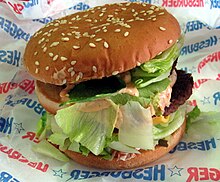

Korean-style bulgogi burger

Craven burger with rice bun (sold in Taiwan, Korea, Hong Kong, Macao, the Philippines, Thailand and Singapore). Note that the "bun" is composed of cooked rice

In Finland, hamburgers are sometimes served in buns made of rye instead of wheat.
Eastern asia
Rice burgers, mentioned above, are as well available in several Due east Asian countries such as Taiwan and S Korea. Lotteria is a large hamburger franchise in Nippon endemic by the Southward Korean Lotte group, with outlets too in Red china, Due south Korea, Vietnam, and Taiwan. In add-on to selling beef hamburgers, they likewise have hamburgers made from squid, pork, tofu, and shrimp. Variations available in Republic of korea include Bulgogi burgers and Kimchi burgers.
In the Philippines, a broad range of major U.S. fast-nutrient franchises are well represented, together with local imitators, often amended to the local palate. The chain McDonald's (locally nicknamed "McDo") has a range of burger and chicken dishes ofttimes accompanied by patently steamed rice or French fries. The Philippines boasts its own burger-chain called Jollibee, which offers burger meals and chicken, including a signature burger called "Champ". Jollibee at present has a number of outlets in the United States, the Middle E and East asia.
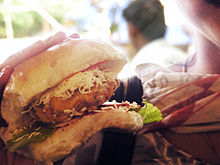
Vada pav or "Indian Burger" is made of potatoes and spices.
India
In Bharat, burgers are ordinarily made from craven or vegetable patties due to cultural beliefs against eating beef (which stem from Hindu religious exercise) and pork (which stems from Islamic religious do). Because of this, the majority of fast food chains and restaurants in India do not serve beef. McDonald's in India, for example, does non serve beef, offer the "Maharaja Mac" instead of the Big Mac, substituting the beef patties with chicken. Another version of the Indian vegetarian burger is the Wada Pav consisting deep-fried potato patty dipped in gramflour batter. Information technology is normally served with mint chutney and fried green chili. Another alternative is the "Buff Burger" made with buffalo meat.[94]
Pakistan
In Pakistan, autonomously from American fast food chains, burgers tin can be found in stalls almost shopping areas, the best known beingness the "shami burger". This is made from "shami kebab", made by mixing lentil and minced lamb.[95] Onions, scrambled egg and ketchup are the most popular toppings.
Malaysia
In Malaysia there are 300 McDonald's restaurants. The menu in Malaysia also includes eggs and fried chicken on top of the regular burgers. Burgers are also easily found at nearby mobile kiosks, especially Ramly Burger.
Mongolia
In Mongolia, a recent fast food craze due to the sudden influx of foreign influence has led to the prominence of the hamburger. Specialized fast food restaurants serving to Mongolian tastes have sprung up and seen nifty success.

Turkey
In Turkey, in addition to the internationally familiar offerings, numerous localized variants of the hamburger may be constitute, such as the Islak Burger (lit. "Wet-Burger"), which a beef slider doused in seasoned tomato sauce and steamed inside a special glass bedroom, and has its origins in the Turkish fast food retailer Kizilkayalar. Other variations include lamb-burgers and offal-burgers, which are offered by local fast food businesses and global bondage alike, such as McDonald's and Burger King. Most burger shops take also adopted a pizzeria-similar approach when it comes to dwelling house delivery, and well-nigh all major fast food chains deliver.
Yugoslavia and Serbia
In the former Yugoslavia, and originally in Serbia, at that place is a local version of the hamburger known as the pljeskavica. It is often served every bit a patty, but may accept a bun as well.
Belgium and Netherlands
Throughout Kingdom of belgium and in some eateries in the netherlands, a Bicky Burger is sold that combines pork, chicken, and horse meat.[96] [97] The hamburger, usually fried, is served between a bun, sprinkled with sesame seeds. It oftentimes comes with a specific Bickysaus (Bicky dressing) made with [96] mayonnaise, mustard, cabbage, and onion.[96]
Unusual hamburgers
- In May 2012, Serendipity 3 was recognized every bit the Guinness World Record holder for serving the world's virtually expensive hamburger, the $295 Le Burger Improvident.[98]
- At $499, the world'due south largest hamburger commercially bachelor tips the scales at 185.8 pounds (84.3 kg) and is on the menu at Mallie's Sports Grill & Bar in Southgate, Michigan. It is called the "Admittedly Ridiculous Burger", which takes nigh 12 hours to prepare. It was cooked and adjudicated on May xxx, 2009.[99]
- A $777 Kobe beef and Maine lobster burger, topped with caramelized onion, Brie cheese and prosciutto, was reported available at Le Burger Brasserie, inside the Paris Las Vegas casino.[100]
- On August five, 2013, the offset hamburger made from meat lab grown from cow stalk cells was served. The hamburger was the result of research in the Netherlands led by Mark Postal service at Maastricht Academy and sponsored by Google'due south co-founder Sergey Brin.[101]
Slang
- "$100 hamburger" ("hundred-dollar hamburger") is aviation slang for a general aviation pilot needing an alibi to fly. A $100 hamburger trip typically involves flight a short distance (less than two hours), eating at an drome eatery, and flying home.[102]
Run into too
- Cheeseburger
- Chicken sandwich
- Chicken nugget
- French fries
- Frikadeller
- Frikandel
- Kofta
- Hamburg steak
- Hot dog
- List of hamburgers
- List of hamburger restaurants
- List of sandwiches
- Meat grinder
- Pljeskavica – a traditional Balkan meal
- Salisbury steak
- Sloppy joe – Variety of sandwich fabricated with ground meat
- Steak sandwich
References
- ^ "The history of the burger". Archived from the original on October 15, 2019. Retrieved October 15, 2019.
- ^ a b "Recipes for tasty, crunchy & saucy American mode sandwiches". Unilever Food Solutions. Archived from the original on Feb 9, 2022. Retrieved Feb 9, 2022.
Wait a blank wait if you're in u.s. and inquire for a craven burger 'cause they ain't got a clue what the hell you're talking about... It's just what nosotros phone call burgers, Americans phone call sandwiches...
- ^ "14 Names Other Countries Have For Nutrient That Will Confuse Every Aussie". Punkee. July 30, 2021. Retrieved Feb 9, 2022.
- ^ Harper, Douglas. "hamburger". Online Etymology Lexicon . Retrieved October 17, 2009.
- ^ Burger Merriam-Webster Dictionary
- ^ McWilliams, Marker (April 6, 2012). The Story behind the Dish: Archetype American Foods: Classic American Foods. ABC-CLIO. ISBN9780313385100.
- ^ "Neuester, vollständiger Führer durch Hamburg, Altona und Umgegend : Mit Berücksichtigung von Kiel, Helgoland, Lübeck und Travemünde. Mit vielen lithogr. Abbildungen u. d. neuesten Airplane der Stadt" [Newest, complete guide to Hamburg, Altona and surroundings. [...]]. Bavarian National Library Archives. Hamburg: J. F. Richter. 1869. Retrieved January 11, 2017.
- ^ "In a "Sandwich Car"". Chicago Daily Tribune. July 5, 1896. Retrieved August 7, 2014.
- ^ a b c "Who invented the hamburger? Biting into the messy history of America's iconic sandwich". Washington Post. ISSN 0190-8286. Retrieved December 16, 2021.
- ^ Sam Gazdziak (Baronial 1, 2006). "Giving the BURGER its due: the hamburger'south origins are somewhat shrouded in mystery, but there is no dubiety equally to its bear on on American dining habits and culture.(Editorial)." The National Provisioner. BNP Media.
- ^ a b c d e f g Nancy Ross Ryan (Feb half-dozen, 1989). Neat American food chronicles: the hamburger. (eating place marketing). Restaurants & Institutions. Reed Business Information, Inc. (Us).
- ^ Lance Gay Scripps (April ii, 2004). Birth of an icon: Hamburger's origins unclear, merely it became popular 100 years agone. Deseret News (Salt Lake City).
- ^ Berman, John; Millhon, Drew (February 20, 2007). "A Major Beef! Who Invented the Hamburger?". ABC News. Retrieved May 24, 2014.
- ^ Rosa L. DeLauro (2000). Louis' Lunch. the Library of Congress.
- ^ Louis' Luncheon A Local Legacy. Library of Congress. Americaslibrary.gov. Retrieved on April 21, 2013.
- ^ U.Due south. Library of Congress Folklife Center Local Legacies Project retrieved on April thirteen, 2009 Louis' Lunch A Local Legacy
- ^ About Connecticut. State of Connecticut official website
- ^ Jane Stern; Michael Stern (1977). "Roadfood". New York Magazine. p. 42. ISSN 0028-7369.
- ^ a b c Randall Beach (Feb 3, 2008) Louis' Lunch has beef with book claiming it didn't invent the hamburger. New Haven Register (New Haven, CT). McClatchy-Tribune Information Services.
- ^ a b c d east f m John E. Harmon "The Meliorate Burger Boxing", in Atlas of Pop Culture in the Northeastern United states of america.
- ^ ""Hamburger" Charlie Nagreen". SeymourHistory.org. Retrieved September 3, 2010.
- ^ Heuer, Myron (October 12, 1999). "The real domicile of the hamburger". Herald & Journal . Retrieved March 24, 2008.
- ^ Ozersky, Josh (2009). The Hamburger: A History. Yale University Press. p. 19. ISBN978-0-300-15125-1.
- ^ John T. Edge (2005). Hamburgers & Fries: An American Story . G.P. Putnam's Sons. p. 22. ISBN978-0-399-15274-0.
- ^ a b Preusch, Matthew (October 26, 2007). "What'due south cooking America: History of the Hamburger".
- ^ Welcome To Weber'southward Superior Root Beer and Grill Archived January 14, 2013, at the Wayback Motorcar. Webersrootbeer.cyberspace (April thirteen, 1995). Retrieved on Apr 21, 2013.
- ^ "Obituary: Charles Menches". The New York Times. October v, 1951.
- ^ Grivetti, Louis E.; Corlett, Jan L.; Gordon, Bertram M.; Lockett, Cassius T. (January–February 2004). "Food in American History, Function 6-Beef (Part 1): Reconstruction and Growth Into the 20th Century (1865–1910)". Diet Today. 39 (1): 18–25. doi:10.1097/00017285-200401000-00006. PMID 15076706.
- ^ Roger M. Grace (Jan 15, 2004). Former Menus Tell the History of Hamburgers in L.A. metnews.com.
- ^ "Hoover's Company Profiles: White Castle Organization, Inc". Answers.com.
- ^ Hogan, David Gerard (1997). Selling 'em past the Sack: White Castle and the Creation of American Nutrient (1st ed.). NYU Printing. pp. 52–55. ISBN978-0814735671 . Retrieved June four, 2008.
- ^ "Ray Kroc Dies - McDonald's company history". The Washington Postal service.
- ^ For references meet the literature review in William O. Giles "Method for preparing hamburger patties" U.S. Patent 5,484,625 issued January 16, 1996.
- ^ Large Mac Hits The Big 4-0, CBS News, February xi, 2009.
- ^ "Anatomy of a Burger". The New York Times. October 4, 2009. Retrieved May 4, 2010.
- ^ Moss, Michael (October 3, 2009). "The Burger That Shattered Her Life". The New York Times . Retrieved May 4, 2010.
- ^ "Ground Beef and Food Condom". Retrieved July 26, 2016.
- ^ USDA Urges Consumers To Apply Food Thermometer When Cooking Footing Beef Patties Archived September 3, 2009, at the Wayback Car. United States Department of Agriculture Safety and Inspection Service Media Communications Function, Baronial eleven, 1998.
- ^ "Orange Coast Mag". Orange Coast. Emmis Communications: 254. May 2007. ISSN 0279-0483.
- ^ Seenan, Gerard (October 4, 2004). "Highland schools go Bambi burgers". The Guardian. London. Retrieved May 4, 2010.
- ^ Ronald R. Butters, "Trademark linguistics: Trademarks: Linguistic communication that ane owns", in Malcolm Coulthard, Alison Johnson, The Routledge Handbook of Forensic Linguistics, p. 360
- ^ George Motz, Hamburger America, 2011 ISBN 0762440708, p. 17, 41
- ^ Thomas Riggs, Encyclopedia of major marketing campaigns, 2:456
- ^ a b c d Perry, Catherine D., District Judge (July vii, 2004). "Memorandum and Gild" (PDF). The Steak 'n Shake Company vs. The Burger Rex Corporation, Case No. iv:04CV525 CDP. U.s. District Court, Eastern Commune of Missouri, Eastern Division. Archived from the original (PDF) on September 28, 2013. Retrieved October 12, 2014. (July vii, 2004) 323 F. Supp.2d 983 (E.D. Mo. 2004)
- ^ a b c Michael Karl Witzel, Gyvel Young-Witzel (2007). Legendary Route 66. p. 210. ISBN9781616731236.
- ^ a b Brimer, Jeffrey; Smith-Porter, Leslie (2005). Annual Franchise and Distribution Law Developments. pp. 109–110. ISBN9781590314319.
- ^ "Steak n Milkshake | Steakburger & Homemade Milkshakes". world wide web.steaknshake.com.
- ^ Rock, Martha (August 10, 2014). Be Your Own Burger King. PJ Grouping. p. fourteen.
- ^ Croft, Sara (Oct 9, 2014). "Brand your own great steak burger". The Indianapolis Star . Retrieved October 9, 2014.
- ^ Louie, Elaine (2008). London . New York Review of Books. p. 14. ISBN9781892145659.
- ^ "Steak Sandwich Around Australia". Outback Joe. April 2012. Retrieved July 18, 2017.
- ^ a b c Kearney, Syd (May two, 2014). "One great dish: Signature Steak Burger at La Casa del Caballo". Houston Chronicle . Retrieved October nine, 2014.
- ^ The Little Black Volume of Burgers. Peter Pauper Press, Inc. p. 99. ISBN978-1441300409.
- ^ Motz, George (May 10, 2011). Hamburger America. pp. 41–42. ISBN9780762440702.
- ^ Life. Nov 10, 1967. p. 83.
- ^ a b Annual Review of Developments in Business and Corporate Litigation. 2006. pp. 1075–1076. ISBN9781590315460.
- ^ A.V. Order (October 13, 2009). Inventory. p. 186. ISBN9781439109892.
- ^ Levine, Ed (Nov 2011). Serious Eats. pp. 80–81. ISBN9780307720870.
- ^ Taylor, Peter (August 31, 2011). Brit at the Ballpark. p. 97. ISBN9780786486472.
- ^ Specialty Sandwich commercial (Television commercial). 1979.
- ^ Sasser, Due west. Earl Jr.; Rikert, David C. (February 27, 1996). "Burger King Corp". Harvard Business concern Review. Cambridge, MA. Retrieved November 25, 2013.
- ^ a b Peter Shinkle (June 16, 2004). "Burger boxing heats up in court". St. Louis Mail-Dispatch. Metro.
- ^ "Steak 'due north Shake sues Burger Rex over use of "steakburger" phrase". The Florida Times-Union. Associated Press. June ii, 2004. Retrieved February 22, 2015.
- ^ 4:04cv525, Steak N Shake Company et al v. Burger King Corporation CourtLink docket.
- ^ "Superlative x National Dishes -- National Geographic". Travel. September 13, 2011. Retrieved August viii, 2020.
- ^ "How Much Does A 100x100 In-N-Out Cheeseburger Price?". Robert Kaplinsky.
- ^ John T. Edge (July 29, 2009). "Pastrami Meets the Patty in Utah". The New York Times.
- ^ Slider or Slyder (mini-hamburger). Barry Popik, February 14, 2008.
- ^ Keith Plocek (February 21, 2008). Sliders, Rollers and Monkey Dicks. Houston Printing.
- ^ The Canadian Oxford Dictionary has headwords for the Canadianisms "kubasa", "kubie" (as a hot dog), and "kubie burger", the latter two being specific to Alberta.
- ^ a b c xvi Regional American Burgers, April seventh, 2021
- ^ "How the Fat Male child burger became a Winnipeg icon". CBC.ca. Retrieved May 14, 2021.
- ^ The Low Carb Half dozen Dollar Burger | Carl's Jr. Card Archived Oct two, 2010, at the Wayback Machine. Carlsjr.com. Retrieved on April 21, 2013.
- ^ "Low Carb, Vegetarian, Gluten-Sensitive* & Low Fat Options at Hardee'southward". Archived from the original on Jan xiv, 2010. Retrieved September eighteen, 2010. . hardees.com
- ^ McCracken, Jan (2005). Good for you Carb Cookbook For Dummies. For Dummies. p. 294. ISBN978-0-7645-8476-iii.
- ^ "Move over, Cronut! The new Ramen Burger has New Yorkers in a foodie frenzy". New York Post. August 21, 2013.
- ^ Audrey Parfait (July sixteen, 2012). "Les Français, deuxièmes plus gros consommateurs de hamburgers en Europe". world wide web.lexpress.fr. .
- ^ "Le burger détrône le sandwich jambon-beurre". www.ladepeche.fr. February vi, 2014. .
- ^ Schwartz, Jeremy (August 27, 2007). "Uncovering United mexican states: Best of times, worst of times: Jubilant the 100th". Statesman.com. Archived from the original on November ii, 2007. Retrieved December eighteen, 2010.
- ^ "Wimpy History". wimpy.united kingdom.com. Archived from the original on May nine, 2008.
- ^ Lacey, Josh (Jan 2, 2006). "Camembert with that, sir?". The Guardian. London. Retrieved May four, 2010.
- ^ "Third Wave Burgers". London Menu Trends 2012. LostinCatering.
- ^ "Rustler's Microwave Quarterpounder 190g". sainsburys.co.united kingdom. Archived from the original on Oct one, 2011. Retrieved April 25, 2010.
- ^ "Fed: Tough to swallow inflationary hamburgers". Australian Associated Press General News. Australian Associated Press. July 26, 2006.
- ^ Hay, Donna (November 24, 2002). "The new burger". Sunday Herald Sun. The Herald and Weekly Times.
- ^ "Hungry Jack's carte du jour". Retrieved March 10, 2012.
- ^ a b "汉堡和三明治有什么区别?强力科普这些外来词!". Sohu. August one, 2017.
- ^ "Chinese Hamburger, Rou Jia Mo 肉夹馍". The Woks of Life. March 4, 2017. Retrieved January v, 2020.
- ^ Shah, Khushbu (April 14, 2015). "China Brazenly Claims it Invented the Hamburger". Eater . Retrieved Jan 5, 2020.
- ^ "The World'southward Beginning Hamburger Comes From Where?". HuffPost. Apr 8, 2015. Retrieved January five, 2020.
- ^ "Ideaforesight: Upscale, modern fast nutrient". ideaforesight's blog. July 11, 2010.
- ^ "Danmarks første bøfsandwich fylder 70". Mynewsdesk (in Danish). Retrieved March 10, 2021.
- ^ "Flæskestegssandwich | Vores opskrift på den bedste flæskestegssandwich". meyers.dk . Retrieved March 10, 2021.
- ^ "Bite Into xi Of The Best Burgers In Pune | LBB". LBB, Pune.
- ^ Fried lamb burger recipe on Recidemia. En.recidemia.com (July fifteen, 2012). Retrieved on April 21, 2013.
- ^ a b c Steves, Rick (2015). Rick Steves Belgium: Bruges, Brussels, Antwerp & Ghent. Avalon Travel. ISBN978-1631210655.
- ^ Smith, Andrew F. (2008). "The Global Burger". Hamburger a global history . London: Reaktion Books. ISBN978-1861896315.
- ^ "Serendipity 3 - Burger Weekly". Burger Weekly. Burger Weekly. June 12, 2013. Retrieved October 8, 2013.
- ^ "Largest hamburger commercially available". guinnessworldrecords.com. Archived from the original on June 7, 2009.
- ^ Ungerleider, Neal (June four, 2009). "ten Well-nigh Expensive Hamburgers". Forbes. Archived from the original on June 12, 2009.
- ^ "World's first lab-grown burger is eaten in London". BBC. Baronial five, 2013. Retrieved August 5, 2013.
- ^ Matthew Preusch (October 26, 2007). Cleared for Lunching: The $100 Hamburger. NY Times.
Further reading
- Barber, Katherine, editor (2004). The Canadian Oxford Lexicon, second edition. Toronto, Oxford University Press. ISBN 0-xix-541816-half dozen.
- Edge, John T. (2005). Hamburgers & Fries: An American Story . Chiliad.P. Putnam'due south Sons. ISBN978-0-399-15274-0. History and Origins of the Hamburger
- Trage (1997). The Food Chronology: A Nutrient Lover's Compendium of Events and Anecdotes, From Prehistory to the Present. Owl Books. ISBN978-0-8050-5247-three.
- Allen, Beth (2004). Peachy American Classics Cookbook . Hearst Books. ISBN978-1-58816-280-ix.
- Smith, Andrew (2008). Hamburger: A Global History . Reaktion Books. p. 128. ISBN978-1-86189-390-ane.
- Volger, Lukas (2010). Veggie Burgers Every Which Solar day: Fresh, Flavorful and Salubrious Vegan and Vegetarian Burgers - Plus Toppings, Sides, Buns and More. The Experiment. ISBN978-1-61519-019-five.
External links

johnsonposiciente.blogspot.com
Source: https://en.wikipedia.org/wiki/Hamburger
0 Response to "Why Is It Called a Hamburger if It's Made Out of Beef"
Enregistrer un commentaire